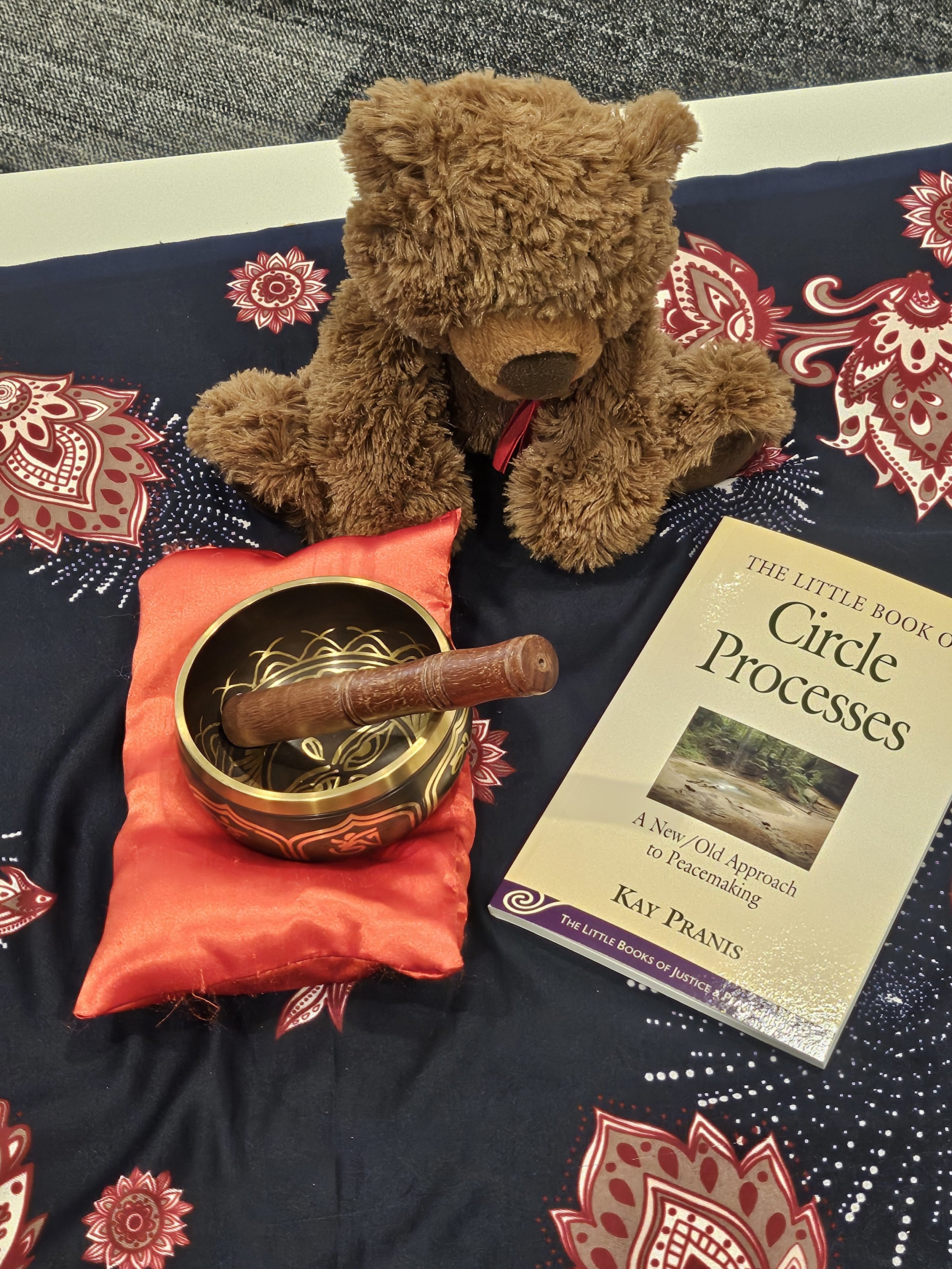
Example of a circle centerpiece with a tablecloth, singing bowl, and talking piece.
What is a restorative circle?
A restorative circle is a simple but powerful way for people to come together, speak honestly, and listen to each other with respect. People can use circles to build community, share, and reach consensus (if that’s a goal). Circles can be used in classrooms, workplaces, neighborhoods, and community groups to build, strengthen, and heal relationships.
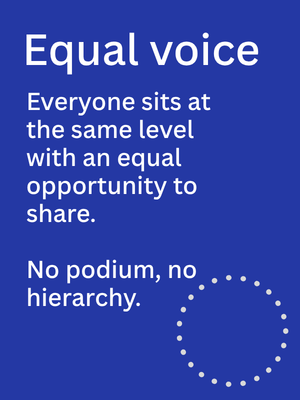
Circles usually incorporate elements that are meaningful to the location, the participants or their community. These elements can form a centerpiece, placed in the middle and accessible to all. Elements might include a tablecloth or other textile, and a bell, candle, or chime which is used to signify the opening and closing of the circle process. The circle keeper also uses an object which has a special significance to them or the group as a talking piece, which is passed around the circle. This gives each person an equal opportunity to speak, if they choose.
“Everyone’s voice matters, and community is built through listening to one another.”
How it works
3 things that make circles different
Purpose
What are circles for?
Circle Types
Finding the right circle for your situation
-
A safe space to connect around shared values and concerns. No specific outcome expected.
-
People with different perspectives share how they've come to believe what they believe, without trying to persuade.
-
For those who've experienced a shared event. Each person participates at whatever level feels right.
-
A closed circle for those whose identity is being discriminated against, used to connect and support one another.
-
Multiple tables, each with a different question, bringing diverse voices together in small conversations.
-
Two facing circles used to practice active listening, restating, and icebreaking in a structured way.
-
A small group discusses in the center while others observe. Used for modeling how issues get resolved.
-
Like the fishbowl, but participants rotate in and out of the center, giving more voices a chance to be heard.
Ready to learn more?
CCR offers an Introduction to Circle Facilitation and other community workshops on restorative processes!